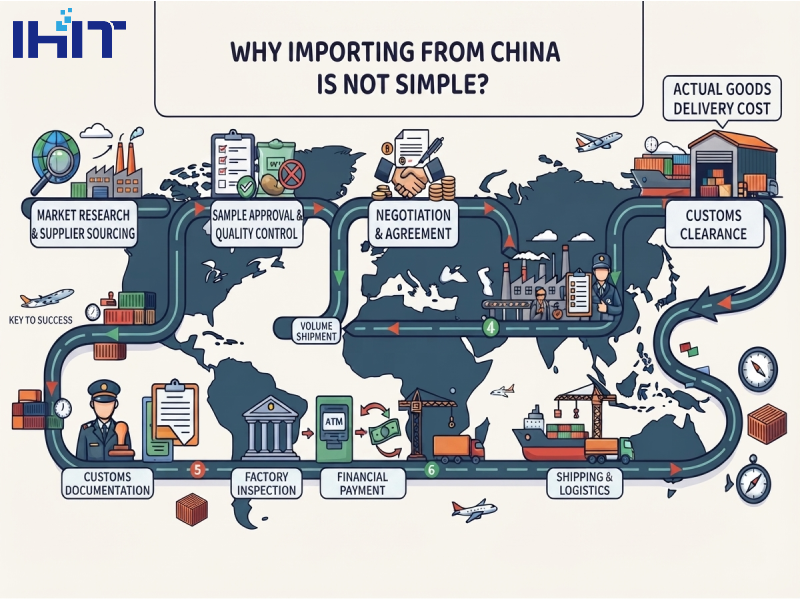

The price listed on a Chinese supplier’s pro forma invoice is not the final cost of importing goods into Iran. To estimate the actual cost more accurately, you need to consider factors such as customs value, customs duties, commercial profit tax, value-added tax, and other related charges. The amount of these costs depends on the type of goods, their HS Code, the declared value, shipping costs, and the customs regulations applicable in the relevant year.
At Iran House of Innovation and Technology, reviewing these factors before finalizing a purchase can help businesses make a more accurate estimate of the total landed cost. Below, we explain how import tariffs from China are calculated, how customs value and import duties are determined, and how to estimate customs-related costs using a numerical example.
What Is the Import Tariff on Goods from China?
In practice, import tariffs refer to the rates applied to goods when they enter the country based on their tariff classification. In Iran, “import duties” consist of customs duties and commercial profit tax, and the applicable rate is not the same for every product. Therefore, it is not accurate to assume that every product imported from China is subject to, for example, a 10% or 20% tariff. The product specifications and its HS Code must first be determined.
When estimating the customs cost of importing from China, you should not simply multiply the purchase price by the tariff rate. The customs value and the exchange rate used for customs calculations also have a direct impact on the final amount.
Read also: Why Is Importing from China Not as Simple as It Seems?
What Components Make Up the Import Duties on Goods from China?
Import duties at customs consist of customs duties and commercial profit tax. The applicable rates are determined according to the product’s tariff classification and the regulations in force for that year. Therefore, when calculating the import tariff from China, the first step is to identify the product’s tariff code or HS Code and check the corresponding rate.
What Are Customs Duties?
Customs duty is one of the two components that make up import duties. Under Iran’s Customs Affairs Law, the customs duty rate for most tariff classifications is generally set at 4% of the customs value of the goods. However, this rate is not universal and may differ for certain products or product groups based on annual budget laws or government decisions. For this reason, the exact customs duty for a specific product should be verified against its tariff classification (HS Code) and the current year’s tariff schedule.
What Is Commercial Profit Tax?
Commercial profit tax is the other component of import duties. Its rate is determined according to the product’s tariff classification and the government’s trade policies. As a result, different products with similar purchase values may be subject to different commercial profit tax rates and, consequently, different import duties.
What Is the Difference Between Customs Duty, Commercial Profit Tax, and Import Duties?
These three terms are not interchangeable. Customs duty and commercial profit tax are the two main components of import duties, and their combined amount constitutes the import duty payable under the applicable regulations.
Therefore, when reviewing the import tariff from China, it is important to clarify whether you are referring to the overall import duty rate or customs duty alone, as these are two different figures.
For more information: What Products Should You Import from China?
What Role Does HS Code Play in Determining Import Tariffs?

An HS Code is the classification code used to identify goods within the customs classification system. Import duty rates, licensing requirements, and certain import regulations are determined based on this classification. Choosing the correct code is therefore more than an administrative step; it can directly affect the amount you have to pay.
Choosing the correct HS Code is particularly important when determining import duties. Business consulting services can help businesses review product specifications, purchasing documents, and the requirements associated with a particular tariff classification to make a more informed decision.
How Can You Find the HS Code for Goods Imported from China?
To determine the correct code, you need to examine the product type, material, intended use, technical specifications, operating method, and, in some cases, its components. The brand name or product description provided by a Chinese supplier on a pro forma invoice is not, by itself, sufficient to determine the correct tariff classification. When the technical specifications are unclear and direct follow-up with the supplier or sample inspection is required, a shared office in China can provide a practical base for handling this part of the process.
If a product comes in several models or has different applications, each model should ideally be assessed based on its own specifications. Using one general code for different products can lead to an incorrect estimate of import duties or create problems when the goods are declared to customs.
How Is the Customs Value of Goods Calculated?
The customs valuation is not based solely on the price shown on the invoice. Under normal circumstances, customs value is determined based on the value of the goods plus relevant costs incurred up to the point of entry, including shipping and insurance. This basis is generally referred to as the CIF value. Therefore, the import tariff from China should be assessed based on the customs value rather than simply the amount paid to the supplier.
For example, if the value of the goods is $10,000 and shipping and insurance cost $1,200, the initial value used for customs calculations would be $11,200. However, the final value accepted by customs is subject to the supporting documents and applicable valuation rules.
What Is the Formula for Calculating Import Tariffs from China?
For a basic estimate, the calculation can be broken down into the following steps:
Customs value × customs duty rate = customs duty
Customs value × commercial profit tax rate = commercial profit tax
Customs duty + commercial profit tax = import duties
After that, value-added tax and other statutory charges, where applicable, are calculated separately. Therefore, calculating the import tariff from China is not simply a matter of multiplying the purchase price by a single rate; it involves several stages.
How Is VAT on Imports Calculated?
Import VAT is not the same as import duties. Its calculation base is the customs value plus the import duties (customs duty + commercial profit tax).
The general VAT rate in 1405 is 10%, although for certain goods, customs directives may apply rates of 11% or 12%. This tax is generally charged in addition to import duties rather than replacing them, and the exact rate applicable to each product should be verified separately.
An Example of Calculating the Import Tariff from China
Suppose an importer purchases goods from China for $10,000 and pays $1,200 for shipping and insurance to Iran. In this example, the customs value is considered to be $11,200.
Now assume that the combined customs duty and commercial profit tax rate for that tariff classification is 20%. The calculation would be:
11,200 × 20% = $2,240 import duties
This example is intended only to demonstrate how the import tariff from China is calculated. The 20% rate should not be generalized to all goods imported from China. After this step, VAT and any other charges applicable to the goods under the relevant regulations must be calculated separately.
What Is the Import Tariff from China in 1405?
There is no single tariff rate that applies to all goods imported from China in 1405. The applicable import duty is determined according to the tariff classification and type of product, and the tariff schedule and budget provisions for that year should be used as the basis for calculation. The 1405 tariff schedule specifies different customs duty and commercial profit tax rates for different tariff classifications.
In 1405, the exchange rate used to calculate import duties for other goods is also determined based on the average exchange rate of transactions through the official foreign exchange center in Bahman 1404. Therefore, the free-market exchange rate should not be used when converting the foreign-currency amount into Iranian rials for customs calculations.
How Is the Exchange Rate for Calculating Import Duties Determined?
Even if you know the product price and the applicable import duty rate, you still need to know the exchange rate used in customs calculations to determine the final amount in Iranian rials. This rate is not necessarily the same rate used by the importer to purchase foreign currency or pay the supplier.
For this reason, when estimating the customs cost of importing from China, the foreign-currency value of the goods should be considered separately from the exchange rate used by customs. The exchange rate used as the basis for import duties is announced under the annual regulations, and different rules may apply to specific categories of goods.
What Costs Must Be Paid in Addition to the Import Tariff?
The tariff is only one part of the total cost of bringing goods into the country. Depending on the type of product and the import process, additional costs may include VAT, statutory charges, customs service fees, warehousing, inspection, customs clearance, and domestic transportation.
The tariff is therefore only one component of the total import cost. Expenses such as warehousing, inspection, customs clearance, and inland transportation may also be added to the final cost.
What Information Is Needed to Accurately Calculate the Cost of Importing from China?
Before calculating the final figure, you should have at least the following information available:
- Exact product specifications
- HS Code or tariff classification
- Product value stated on the invoice
- Shipping cost
- Insurance cost, if applicable
- Country of origin
- Product quantity and volume
- Customs duty rate
- Commercial profit tax rate
- Customs exchange rate
- VAT status
- Any product-specific duties or regulations
The more accurate the product information, the more reliable your estimate of the import tariff from China will be. The same basic information is required when calculating the import tariff on goods from China.
What Are the Common Mistakes When Calculating Import Tariffs from China?
To avoid a significant difference between your estimated costs and the final customs clearance cost, it is important to account for the following common mistakes:
Calculating based only on the purchase price: Shipping and insurance costs may also affect the customs value.
Using one fixed rate for all products: Commercial profit tax and import duties depend on the product’s tariff classification.
Treating import duties as the total customs clearance cost: VAT, statutory charges, and service fees may be added separately to the final cost.
Choosing the wrong HS Code: Determining the tariff classification solely based on the product name or the supplier’s suggestion, without reviewing the technical specifications, can make the entire calculation inaccurate and create a difference between the initial estimate and the final amount declared to customs.
How Can You Estimate Customs Costs Before Buying from China?
To estimate customs costs before making a purchase, first determine the product specifications and its tariff classification. Then calculate the product value, shipping and insurance costs, and the applicable rates for the current year based on the customs value.
Import facilitation from China can help businesses review sourcing routes, documentation, and import costs before finalizing a purchase. For transactions where additional assurance regarding the financial and commercial commitments of the parties is required, commercial guarantee services can also be considered separately from the customs calculations.
Conclusion: How Is the Import Tariff on Goods from China Calculated?
For an accurate estimate, start by determining the HS Code and customs value of the goods, including eligible shipping and insurance costs. Customs duty, commercial profit tax, and, where applicable, VAT and other statutory charges are then calculated.
The import tariff from China therefore does not have a single fixed rate. It depends on the type of product, tariff classification, customs value, and the regulations applicable in the relevant year. For a more accurate result, calculations should be based on the actual transaction documents and the latest applicable regulations.